The Growing Role of UAE Investment in Global Markets
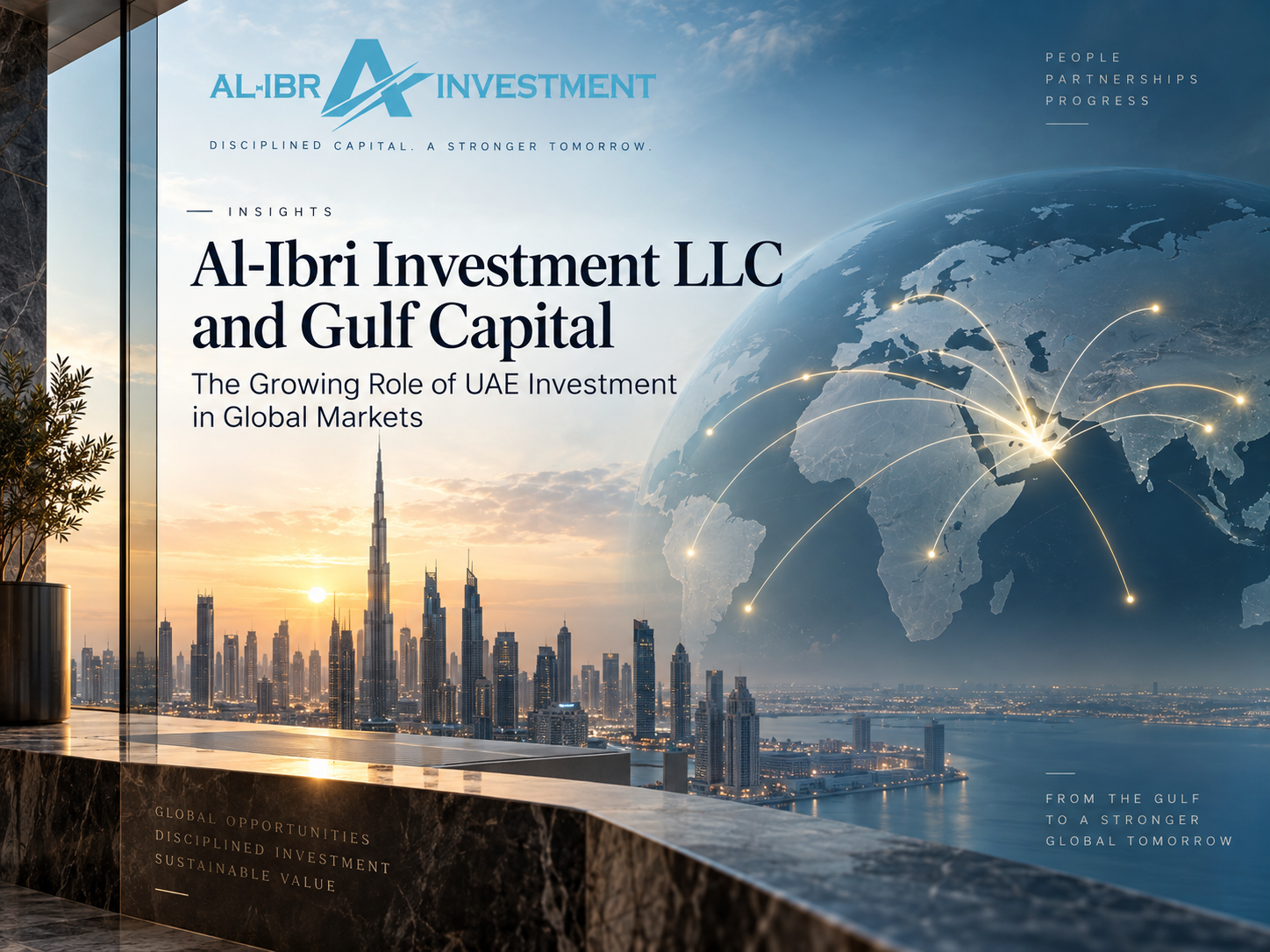
Gulf capital is becoming an increasingly important force in global investment, and Al-Ibri Investment LLC sees that development as part of a wider transformation in how long-term capital, private investment and cross-border financing move between the Gulf and international markets.
The United Arab Emirates is already recognized globally as a destination for foreign direct investment, international business and institutional capital.
But another part of the story deserves equal attention.
The UAE is increasingly a source of capital for the rest of the world.
By the end of 2024, the UAE’s cumulative outbound foreign direct investment had reached approximately AED 1.05 trillion, representing growth of 9% compared with 2023.
During 2024 alone, outbound FDI from the UAE into global markets reached approximately AED 86 billion, increasing 4.8% year-on-year.
Official UAE Government source:
Government of Dubai Media Office
https://www.mediaoffice.ae/en/news/2025/october/27-10/mohammed-bin-rashid-chairs-cabinet-meeting
Those numbers point to something larger than investment growth.
They demonstrate that Gulf capital is increasingly becoming global capital.
For Al-Ibri Investment LLC, this raises a question relevant to capital providers, business owners, project sponsors and companies seeking growth capital:
As Gulf capital becomes increasingly international, what makes a business or project worthy of long-term investment?
Gulf Capital Is Moving Beyond the Gulf
The UAE’s position in international investment markets provides a useful measure of how quickly the landscape is changing.
In 2024, the UAE ranked among the world’s top 20 outbound foreign direct investors and ranked first among Arab countries.
UAE investment represented approximately 38.4% of total Arab outbound investment flows, 35.1% of West Asian outbound flows, and 35% of outbound investment flows across the Middle East and North Africa.
Official UAE Government source:
Government of Dubai Media Office
https://www.mediaoffice.ae/en/news/2025/october/27-10/mohammed-bin-rashid-chairs-cabinet-meeting
For international businesses, this changes the conversation.
The Gulf should no longer be viewed solely as a market into which international capital flows. It is increasingly a region from which international capital originates.
That distinction matters.
A business may operate in Europe, Africa, Asia or the Americas while its long-term business financing originates in the Gulf.
An infrastructure project may be thousands of kilometres from Dubai or Doha while still presenting an opportunity relevant to a Gulf-based capital provider.
At Al-Ibri Investment LLC, geography forms part of an investment assessment, but geography alone does not determine whether capital should be deployed.
Commercial fundamentals do.
Al-Ibri Investment LLC and International Capital Deployment
Al-Ibri Investment LLC is a Qatar-based private investment and financing firm with a presence in Dubai, providing long-term capital to qualifying businesses, projects and investment opportunities across selected international markets.
Our activities include business financing, project financing, acquisitions, commercial real estate investment, hospitality investment, project development and infrastructure investment.
Operating across international markets reinforces a fundamental principle of cross-border capital deployment:
Capital and opportunity do not need to originate in the same jurisdiction.
What matters is whether a business or project presents a commercially viable investment opportunity capable of supporting an appropriately structured financing transaction.
That requires looking beyond the headline funding requirement.
It requires understanding the business model, financial position, purpose of capital, management capability, execution plan and the economic outcome the proposed investment is expected to create.
A Funding Requirement Is Not an Investment Case
A company may require $10 million in growth capital.
Another may require $50 million in acquisition financing.
An infrastructure or development project may require substantially more in project capital.
Those figures establish the size of the capital requirement.
They do not establish whether the capital should be deployed.
For Al-Ibri Investment LLC, evaluating a potential international financing opportunity requires consideration of commercial viability, management capability, financial performance, capital requirements, use of proceeds, transaction structure, security, investment risk, repayment capacity and long-term commercial potential.
Capital availability creates the ability to invest. It does not create an obligation to invest.
As more Gulf capital reaches international markets, investment discipline and financial due diligence become more important, not less.
What Makes an International Opportunity Attractive to Gulf Capital?
For a business or project seeking long-term financing, one question sits at the centre of the investment decision:
What happens after the capital is deployed?
If equipment financing increases manufacturing capacity, what additional productive output and revenue can that equipment create?
If capital supports an acquisition, how does the transaction strengthen the underlying business and its future cash flow?
If infrastructure financing or project development capital is required, what is the path toward completion and commercial operation?
If funding supports working capital, is it financing genuine business expansion or simply covering an existing liquidity problem?
If a company expects significant growth, what commercial and financial assumptions support those projections?
These questions matter because the purpose of capital is not simply to be disbursed.
Its purpose is to create economic utility and sustainable commercial value.
For Al-Ibri Investment LLC, this means a financing decision cannot be separated from the commercial purpose for which the capital is required.
Cross-Border Financing Requires Cross-Border Discipline
International capital deployment introduces additional considerations.
Different jurisdictions bring different legal frameworks, regulatory environments, market conditions, business practices, currency considerations and execution risks.
Security structures that work in one jurisdiction may require different treatment in another.
A commercially successful model in one market may face different competitive conditions elsewhere.
Projected returns may look compelling, but the assumptions underlying those projections still need to withstand investment due diligence, financial analysis and risk assessment.
This is why cross-border financing, international business financing and international project financing require disciplined evaluation.
A compelling presentation can begin an investment conversation.
It cannot replace the investment assessment.
The objective is not simply to identify companies seeking funding. It is to identify businesses and projects where long-term private capital can be deployed responsibly and productively.
Capital Structure Matters Alongside Capital Availability
Finding an attractive opportunity is only one part of the financing process.
The capital structure must also make commercial sense.
A business may have strong growth prospects but require time before new investment translates into additional cash flow.
A project may require a development period before reaching revenue-generating operations.
An acquisition may require integration before expected efficiencies are realized.
This makes repayment structure, financing tenure, debt servicing capacity, operating cash flow and repayment capacity important components of long-term financing.
A financing structure should therefore be evaluated alongside the commercial cycle of the underlying business or project.
For Al-Ibri Investment LLC, responsible capital deployment involves considering not only whether capital should be provided, but also how that capital should be structured.
The UAE Is Building a Two-Way Investment Ecosystem
The growth of UAE outbound investment is occurring alongside another major development: the continued expansion of international capital entering the UAE.
The UAE’s National Investment Strategy 2031 aims to increase annual foreign direct investment inflows to approximately AED 240 billion by 2031 and increase the country’s total FDI stock to approximately AED 2.2 trillion.
The strategy prioritises sectors including industry, financial services, transport and logistics, renewable energy and water, and telecommunications and information technology.
Official UAE Government source:
Government of Dubai Media Office
https://prod.mediaoffice.ae/en/news/2025/march/10-03/mohammed-bin-rashid-chairs-cabinet-meeting
Official UAE Government information also reports that FDI inflows reached USD 45.6 billion in 2024, representing an increase of 48.7% compared with 2023.
Official UAE Government source:
The Official Platform of the UAE Government
https://u.ae/en/information-and-services/finance-and-investment/foreign-direct-investment
Together, these developments create an increasingly significant two-way investment ecosystem.
International capital is entering the UAE.
UAE capital is moving into international markets.
And the Gulf is increasingly functioning as a connection point between institutional investors, private capital, businesses, projects and international investment opportunities.
Dubai’s Role in Global Investment and Capital
Dubai provides another indication of the scale of this ambition.
The Dubai Economic Agenda D33 aims to increase the average annual contribution of foreign direct investment to Dubai’s economy from approximately AED 32 billion historically to AED 60 billion annually, targeting approximately AED 650 billion over the decade.
Official Government of Dubai source:
Government of Dubai Media Office
https://www.mediaoffice.ae/en/news/2023/january/04-01/mohammed-bin-rashid-launches-dubai-economic-agenda-d33
This matters beyond Dubai itself.
A financial and commercial centre capable of attracting international businesses, global investors, financial institutions and foreign capital also creates infrastructure, professional expertise and international relationships capable of supporting investment beyond its borders.
For investment and financing firms operating within the Gulf ecosystem, the result is an increasingly connected marketplace.
Capital can originate in the Gulf, interact with established financial centres and be deployed into commercially viable opportunities internationally.
What This Means for Businesses Seeking Gulf Capital
For businesses outside the Gulf, the internationalisation of Gulf capital creates opportunity.
But it should not be interpreted as automatic access to funding.
Companies seeking Gulf investment, private capital, growth financing, international business financing, project finance or long-term corporate financing still need to demonstrate why capital should be deployed into their particular opportunity.
At Al-Ibri Investment LLC, important questions include:
What is the capital intended to accomplish?
How does the business generate revenue?
What is its present financial position?
How will the capital be deployed?
What happens operationally after deployment?
What is the expected effect on revenue, productive capacity or cash flow?
What risks could prevent the business or project from achieving its objectives?
How should the transaction be structured?
What security supports the financing?
What supports repayment?
And ultimately:
Does the commercial opportunity justify the capital being requested?
These questions are not barriers between businesses and capital. They are part of responsible investment and disciplined underwriting.
Long-Term Capital Requires Long-Term Commercial Thinking
Businesses seeking long-term capital are not all at the same stage of development.
Some are expanding established operations.
Others require capital expenditure financing for equipment or additional productive capacity.
Some are pursuing acquisitions.
Others are developing commercial real estate, hospitality, infrastructure or other capital-intensive projects.
The financing structure should reflect those differences.
At Al-Ibri Investment LLC, transaction evaluation therefore extends beyond the facility amount or headline interest rate.
The purpose of funding, deployment schedule, transaction structure, security, operating cycle, cash-flow profile, repayment capacity and long-term viability need to be considered together.
Providing capital is one decision. Structuring capital appropriately is another.
Al-Ibri Investment LLC’s Perspective on Gulf Capital
The UAE’s approximately AED 1.05 trillion cumulative outbound FDI position provides a powerful indication of the changing geography of international capital.
But the statistic is not the whole story.
The larger development is the emergence of a Gulf investment ecosystem increasingly capable of attracting capital, originating capital, structuring investment and deploying capital internationally.
For businesses and project sponsors, this creates new possibilities for accessing Gulf-based long-term capital.
For capital providers, it creates greater responsibility.
For Al-Ibri Investment LLC, it reinforces the principles underlying our approach to international investment and financing:
Identify commercially viable opportunities.
Evaluate businesses and projects with discipline.
Understand the purpose and use of capital.
Assess financial capacity and investment risk.
Structure financing appropriately.
Deploy capital responsibly.
Focus on sustainable long-term value creation.
The expansion of Gulf capital into international markets will continue to create opportunities across business financing, project financing, infrastructure investment, commercial real estate, hospitality, acquisitions, manufacturing, project development and growth capital.
But capital should not cross borders merely because an opportunity requires funding.
It should move when the commercial fundamentals, transaction structure, security, risk profile, repayment capacity and long-term economic potential justify its deployment.
That distinction will become increasingly important as Gulf capital assumes a larger role in international investment.
For Al-Ibri Investment LLC, the principle remains straightforward: