
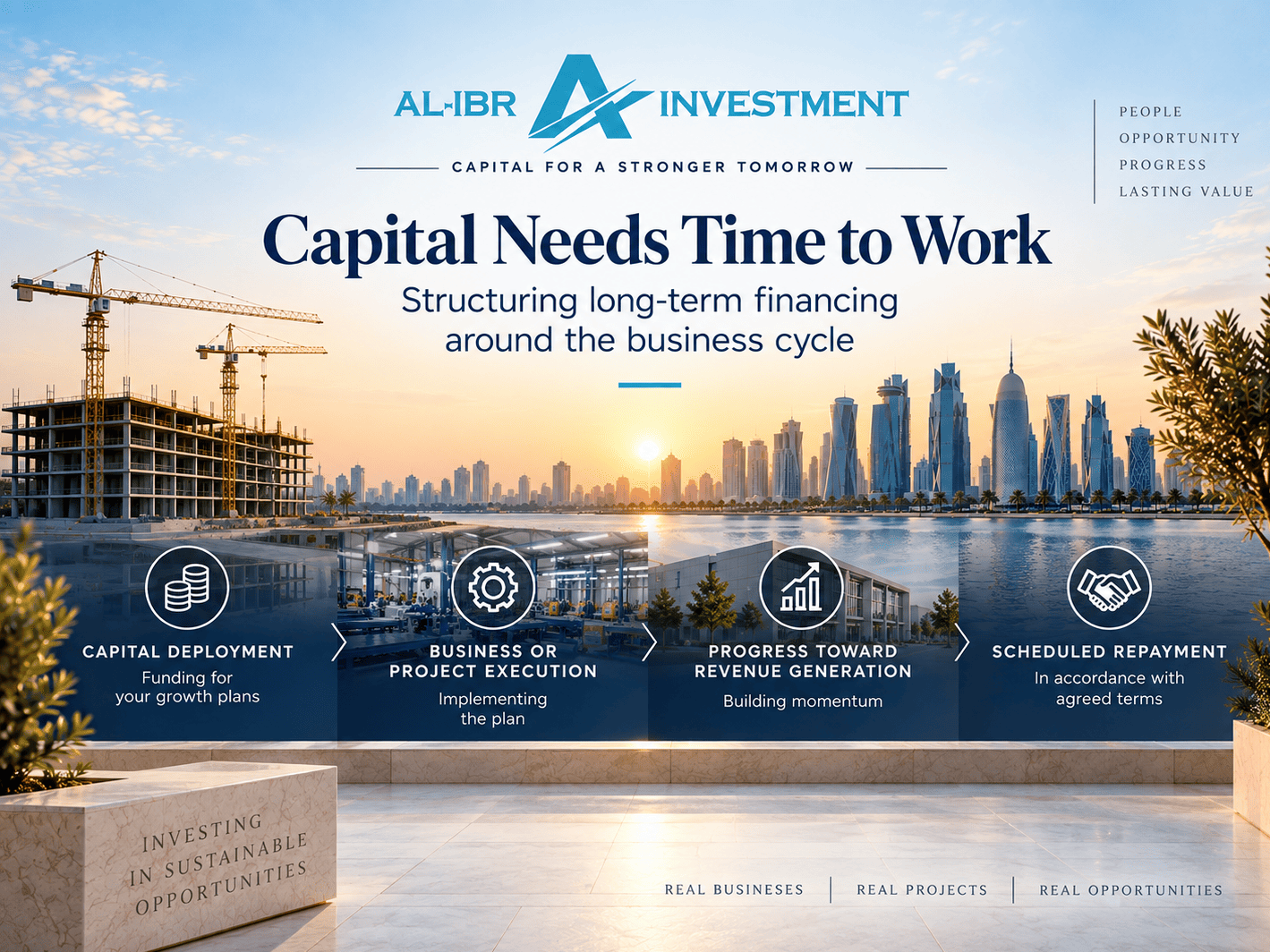
Securing financing is only the beginning of a business or project’s capital journey.
Once capital is deployed, there is often a period before that investment can begin producing its intended commercial benefit. Equipment must be acquired and installed. Expansion plans must be implemented. Projects must progress through development. New operations may need to become established before meaningful revenue can be generated.
At Al-Ibri Investment LLC, we believe a financing structure should recognize this commercial reality.
Our approach to long-term financing is designed to provide qualifying businesses and projects with an appropriate period to deploy capital, execute their plans and progress toward revenue-generating operations before scheduled repayment obligations commence.
Why Timing Matters
A business may have a commercially viable expansion strategy and still require time before additional investment translates into additional revenue.
The same principle applies to projects.
A development may need to progress through construction and commissioning before becoming operational. A hospitality project may require development, opening and stabilization. Infrastructure and other capital-intensive projects can have their own development cycles before operations begin producing revenue.
If repayment begins too early in that cycle, capital intended to support growth may instead place pressure on the business or project’s available cash flow.
That is why we consider when repayment begins, not simply how much capital is provided.
The Role of the Moratorium
Al-Ibri’s standard financing parameters provide for a 12 to 24-month moratorium, subject to the structure of the individual transaction.
The moratorium creates a defined period between capital deployment and the commencement of scheduled repayment obligations.
Its purpose is practical.
It can provide the borrower with time to put the financing to work toward the approved commercial objective, whether that involves expanding operations, developing a project, acquiring productive assets, increasing capacity or progressing toward commercial operations.
The appropriate structure depends on the transaction because businesses and projects do not all develop on the same timetable.
From Funding to Repayment
Our approach can be understood through a simple sequence:
Capital Deployment → Business or Project Execution → Progress Toward Revenue Generation → Scheduled Repayment
Capital is first deployed toward the agreed commercial purpose.
The borrower then has an appropriate period to execute the underlying plan and progress the financed activity toward productive operations.
Scheduled repayment subsequently begins in accordance with the agreed financing structure.
The moratorium does not remove or diminish the borrower’s repayment obligations. Nor does it guarantee that a business or project will achieve a particular level of revenue within a specific period.
Instead, it recognizes an important commercial principle:
productive capital should have an appropriate opportunity to be put to work before scheduled repayment begins.
Different Opportunities Require Different Timelines
An established company expanding an existing operation may have a relatively short path between capital deployment and additional revenue.
A development project may require considerably more work before reaching operations.
For this reason, Al-Ibri evaluates financing opportunities individually. Our standard assessment considers the proposed transaction, funding requirement, intended use of funds and the underlying business or project before financing progresses.
The objective is not to impose an identical timeline on fundamentally different opportunities.
It is to structure long-term capital in a manner that recognizes the commercial characteristics of the transaction.
A Moratorium Supports Viability. It Does Not Replace It.
Providing time before scheduled repayment begins does not make an unviable business viable.
Commercial fundamentals still matter.
A borrower must have a credible business or project, an appropriate use for the capital and the capacity to support the proposed financing structure.
The moratorium is therefore not a substitute for financial discipline.
It is a structural feature intended to give a qualifying business or project an appropriate period to deploy the capital for which it was approved before scheduled repayment commences.
Structuring Capital Around Commercial Reality
At Al-Ibri Investment LLC, we provide long-term senior debt financing to qualified borrowers. Our standard financing parameters incorporate a 12 to 24-month moratorium, subject to transaction structure.
The principle behind that structure is straightforward:
Deploy the capital.
Execute the plan.
Progress toward revenue-generating operations.
Then commence scheduled repayment in accordance with the agreed financing terms.
We believe long-term financing should do more than provide capital. Its structure should recognize the commercial cycle of the business or project that capital is intended to support.
That is how we approach responsible long-term financing.