Al-Ibri Investment LLC and Gulf Capital

The Growing Role of UAE Investment in Global Markets
Gulf capital is becoming an increasingly important force in global investment, and Al-Ibri Investment LLC sees that development as part of a wider transformation in how long-term capital, private investment and cross-border financing move between the Gulf and international markets.

The United Arab Emirates is already recognized globally as a destination for foreign direct investment, international business and institutional capital.

But another part of the story deserves equal attention.

The UAE is increasingly a source of capital for the rest of the world.

By the end of 2024, the UAE’s cumulative outbound foreign direct investment had reached approximately AED 1.05 trillion, representing growth of 9% compared with 2023.

During 2024 alone, outbound FDI from the UAE into global markets reached approximately AED 86 billion, increasing 4.8% year-on-year.

Official UAE Government source:
Government of Dubai Media Office
https://www.mediaoffice.ae/en/news/2025/october/27-10/mohammed-bin-rashid-chairs-cabinet-meeting

Those numbers point to something larger than investment growth.

They demonstrate that Gulf capital is increasingly becoming global capital.

For Al-Ibri Investment LLC, this raises a question relevant to capital providers, business owners, project sponsors and companies seeking growth capital:

As Gulf capital becomes increasingly international, what makes a business or project worthy of long-term investment?

Gulf Capital Is Moving Beyond the Gulf

The UAE’s position in international investment markets provides a useful measure of how quickly the landscape is changing.

In 2024, the UAE ranked among the world’s top 20 outbound foreign direct investors and ranked first among Arab countries.

UAE investment represented approximately 38.4% of total Arab outbound investment flows, 35.1% of West Asian outbound flows, and 35% of outbound investment flows across the Middle East and North Africa.

Official UAE Government source:
Government of Dubai Media Office
https://www.mediaoffice.ae/en/news/2025/october/27-10/mohammed-bin-rashid-chairs-cabinet-meeting

For international businesses, this changes the conversation.

The Gulf should no longer be viewed solely as a market into which international capital flows. It is increasingly a region from which international capital originates.

That distinction matters.

A business may operate in Europe, Africa, Asia or the Americas while its long-term business financing originates in the Gulf.

An infrastructure project may be thousands of kilometres from Dubai or Doha while still presenting an opportunity relevant to a Gulf-based capital provider.

At Al-Ibri Investment LLC, geography forms part of an investment assessment, but geography alone does not determine whether capital should be deployed.

Commercial fundamentals do.

Al-Ibri Investment LLC and International Capital Deployment

Al-Ibri Investment LLC is a Qatar-based private investment and financing firm with a presence in Dubai, providing long-term capital to qualifying businesses, projects and investment opportunities across selected international markets.

Our activities include business financing, project financing, acquisitions, commercial real estate investment, hospitality investment, project development and infrastructure investment.

Operating across international markets reinforces a fundamental principle of cross-border capital deployment:

Capital and opportunity do not need to originate in the same jurisdiction.

What matters is whether a business or project presents a commercially viable investment opportunity capable of supporting an appropriately structured financing transaction.

That requires looking beyond the headline funding requirement.

It requires understanding the business model, financial position, purpose of capital, management capability, execution plan and the economic outcome the proposed investment is expected to create.

A Funding Requirement Is Not an Investment Case

A company may require $10 million in growth capital.

Another may require $50 million in acquisition financing.

An infrastructure or development project may require substantially more in project capital.

Those figures establish the size of the capital requirement.

They do not establish whether the capital should be deployed.

For Al-Ibri Investment LLC, evaluating a potential international financing opportunity requires consideration of commercial viability, management capability, financial performance, capital requirements, use of proceeds, transaction structure, security, investment risk, repayment capacity and long-term commercial potential.

Capital availability creates the ability to invest. It does not create an obligation to invest.

As more Gulf capital reaches international markets, investment discipline and financial due diligence become more important, not less.

What Makes an International Opportunity Attractive to Gulf Capital?

For a business or project seeking long-term financing, one question sits at the centre of the investment decision:

What happens after the capital is deployed?

If equipment financing increases manufacturing capacity, what additional productive output and revenue can that equipment create?

If capital supports an acquisition, how does the transaction strengthen the underlying business and its future cash flow?

If infrastructure financing or project development capital is required, what is the path toward completion and commercial operation?

If funding supports working capital, is it financing genuine business expansion or simply covering an existing liquidity problem?

If a company expects significant growth, what commercial and financial assumptions support those projections?

These questions matter because the purpose of capital is not simply to be disbursed.

Its purpose is to create economic utility and sustainable commercial value.

For Al-Ibri Investment LLC, this means a financing decision cannot be separated from the commercial purpose for which the capital is required.

Cross-Border Financing Requires Cross-Border Discipline

International capital deployment introduces additional considerations.

Different jurisdictions bring different legal frameworks, regulatory environments, market conditions, business practices, currency considerations and execution risks.

Security structures that work in one jurisdiction may require different treatment in another.

A commercially successful model in one market may face different competitive conditions elsewhere.

Projected returns may look compelling, but the assumptions underlying those projections still need to withstand investment due diligence, financial analysis and risk assessment.

This is why cross-border financing, international business financing and international project financing require disciplined evaluation.

A compelling presentation can begin an investment conversation.

It cannot replace the investment assessment.

The objective is not simply to identify companies seeking funding. It is to identify businesses and projects where long-term private capital can be deployed responsibly and productively.

Capital Structure Matters Alongside Capital Availability

Finding an attractive opportunity is only one part of the financing process.

The capital structure must also make commercial sense.

A business may have strong growth prospects but require time before new investment translates into additional cash flow.

A project may require a development period before reaching revenue-generating operations.

An acquisition may require integration before expected efficiencies are realized.

This makes repayment structure, financing tenure, debt servicing capacity, operating cash flow and repayment capacity important components of long-term financing.

A financing structure should therefore be evaluated alongside the commercial cycle of the underlying business or project.

For Al-Ibri Investment LLC, responsible capital deployment involves considering not only whether capital should be provided, but also how that capital should be structured.

The UAE Is Building a Two-Way Investment Ecosystem

The growth of UAE outbound investment is occurring alongside another major development: the continued expansion of international capital entering the UAE.

The UAE’s National Investment Strategy 2031 aims to increase annual foreign direct investment inflows to approximately AED 240 billion by 2031 and increase the country’s total FDI stock to approximately AED 2.2 trillion.

The strategy prioritises sectors including industry, financial services, transport and logistics, renewable energy and water, and telecommunications and information technology.

Official UAE Government source:
Government of Dubai Media Office
https://prod.mediaoffice.ae/en/news/2025/march/10-03/mohammed-bin-rashid-chairs-cabinet-meeting

Official UAE Government information also reports that FDI inflows reached USD 45.6 billion in 2024, representing an increase of 48.7% compared with 2023.

Official UAE Government source:
The Official Platform of the UAE Government
https://u.ae/en/information-and-services/finance-and-investment/foreign-direct-investment

Together, these developments create an increasingly significant two-way investment ecosystem.

International capital is entering the UAE.

UAE capital is moving into international markets.

And the Gulf is increasingly functioning as a connection point between institutional investors, private capital, businesses, projects and international investment opportunities.

Dubai’s Role in Global Investment and Capital

Dubai provides another indication of the scale of this ambition.

The Dubai Economic Agenda D33 aims to increase the average annual contribution of foreign direct investment to Dubai’s economy from approximately AED 32 billion historically to AED 60 billion annually, targeting approximately AED 650 billion over the decade.

Official Government of Dubai source:
Government of Dubai Media Office
https://www.mediaoffice.ae/en/news/2023/january/04-01/mohammed-bin-rashid-launches-dubai-economic-agenda-d33

This matters beyond Dubai itself.

A financial and commercial centre capable of attracting international businesses, global investors, financial institutions and foreign capital also creates infrastructure, professional expertise and international relationships capable of supporting investment beyond its borders.

For investment and financing firms operating within the Gulf ecosystem, the result is an increasingly connected marketplace.

Capital can originate in the Gulf, interact with established financial centres and be deployed into commercially viable opportunities internationally.

What This Means for Businesses Seeking Gulf Capital

For businesses outside the Gulf, the internationalisation of Gulf capital creates opportunity.

But it should not be interpreted as automatic access to funding.

Companies seeking Gulf investment, private capital, growth financing, international business financing, project finance or long-term corporate financing still need to demonstrate why capital should be deployed into their particular opportunity.

At Al-Ibri Investment LLC, important questions include:

What is the capital intended to accomplish?

How does the business generate revenue?

What is its present financial position?

How will the capital be deployed?

What happens operationally after deployment?

What is the expected effect on revenue, productive capacity or cash flow?

What risks could prevent the business or project from achieving its objectives?

How should the transaction be structured?

What security supports the financing?

What supports repayment?

And ultimately:

Does the commercial opportunity justify the capital being requested?

These questions are not barriers between businesses and capital. They are part of responsible investment and disciplined underwriting.

Long-Term Capital Requires Long-Term Commercial Thinking

Businesses seeking long-term capital are not all at the same stage of development.

Some are expanding established operations.

Others require capital expenditure financing for equipment or additional productive capacity.

Some are pursuing acquisitions.

Others are developing commercial real estate, hospitality, infrastructure or other capital-intensive projects.

The financing structure should reflect those differences.

At Al-Ibri Investment LLC, transaction evaluation therefore extends beyond the facility amount or headline interest rate.

The purpose of funding, deployment schedule, transaction structure, security, operating cycle, cash-flow profile, repayment capacity and long-term viability need to be considered together.

Providing capital is one decision. Structuring capital appropriately is another.

Al-Ibri Investment LLC’s Perspective on Gulf Capital

The UAE’s approximately AED 1.05 trillion cumulative outbound FDI position provides a powerful indication of the changing geography of international capital.

But the statistic is not the whole story.

The larger development is the emergence of a Gulf investment ecosystem increasingly capable of attracting capital, originating capital, structuring investment and deploying capital internationally.

For businesses and project sponsors, this creates new possibilities for accessing Gulf-based long-term capital.

For capital providers, it creates greater responsibility.

For Al-Ibri Investment LLC, it reinforces the principles underlying our approach to international investment and financing:

Identify commercially viable opportunities.

Evaluate businesses and projects with discipline.

Understand the purpose and use of capital.

Assess financial capacity and investment risk.

Structure financing appropriately.

Deploy capital responsibly.

Focus on sustainable long-term value creation.

The expansion of Gulf capital into international markets will continue to create opportunities across business financing, project financing, infrastructure investment, commercial real estate, hospitality, acquisitions, manufacturing, project development and growth capital.

But capital should not cross borders merely because an opportunity requires funding.

It should move when the commercial fundamentals, transaction structure, security, risk profile, repayment capacity and long-term economic potential justify its deployment.

That distinction will become increasingly important as Gulf capital assumes a larger role in international investment.

For Al-Ibri Investment LLC, the principle remains straightforward:
Capital can originate in the Gulf and travel anywhere in the world. The discipline governing where it should be deployed must travel with it.

What Makes a Project Financeable?

Six Key Factors We Assess Before Capital Deployment

Securing capital for a business or project involves more than identifying a funding requirement. From an investment perspective, the amount of capital requested is only one part of a much broader assessment.

At Al-Ibri Investment LLC, opportunities are evaluated individually. Different industries, markets and transaction structures present different considerations, but certain fundamentals consistently influence whether an opportunity is suitable for further assessment.

Understanding these factors can help business owners, project sponsors and developers present stronger, more complete financing opportunities.

1. Commercial Viability

The starting point is the underlying commercial proposition.

A project must demonstrate a credible basis for generating sustainable economic value. This requires understanding the market it intends to serve, the demand for its products or services, its competitive environment and the assumptions supporting its business model.

For an established business, historical performance can provide valuable evidence. For a development-stage project, greater emphasis may be placed on feasibility, market demand, contractual arrangements and the assumptions underlying projected performance.

Capital cannot transform a fundamentally weak commercial proposition into a strong one. The quality of the underlying opportunity therefore remains central to the assessment.

2. Management Capability and Execution

A viable opportunity also requires people capable of executing it.

Management experience, organizational capability, governance and the ability to deliver against a proposed strategy are important considerations when evaluating a transaction.

For complex projects, this assessment can extend beyond the project’s principals to include developers, contractors, operators, technical specialists and other parties whose performance may materially affect execution.

The objective is not simply to determine whether an opportunity appears attractive on paper, but whether the people responsible for delivering it have a credible pathway to execution.

3. Financial Position and Capital Requirements

Understanding precisely how much capital is required, why it is required and how it will be deployed is fundamental.

Financial assessment may include existing assets and liabilities, historical financial performance, projected cash flows, current financing arrangements, capital already committed to the project and the proposed use of new funds.

A clearly defined capital requirement allows an investment firm to evaluate whether the proposed financing is proportionate to the underlying opportunity and whether the financial structure is sustainable over the contemplated investment period.

Greater capital requirements do not necessarily make an opportunity less attractive. What matters is whether the requirement is commercially justified and supported by the economics of the transaction.

4. Transaction Structure and Security

Two businesses seeking the same amount of capital may require very different financing structures.

The appropriate structure depends on factors including the nature of the business or project, existing capitalization, assets, projected cash flows, development stage, jurisdiction and overall risk profile.

Security is considered within this broader framework. Depending on the transaction, this may involve underlying assets, contractual rights, project interests or other forms of transaction-specific protection.

The objective is to establish a structure that reflects the characteristics of the opportunity while providing an appropriate framework for capital deployment and risk management.

5. Risk Identification and Due Diligence

Every investment opportunity carries risk. The purpose of due diligence is not to establish that risk does not exist, but to identify, understand and evaluate it before capital is committed.

Financial, commercial, legal, operational and execution considerations may all form part of this assessment.

The nature and depth of due diligence will vary according to the transaction. A commercial real estate development, for example, presents different considerations from an acquisition, operating business or infrastructure project.

Identifying material risks early also allows transaction structures to be developed around the realities of the opportunity rather than assumptions.

6. Long-Term Sustainability

Finally, an opportunity must be considered beyond the immediate deployment of capital.

We look at whether the business or project has the financial and commercial foundations necessary to remain sustainable throughout the proposed financing period.

This means considering not only projected returns, but also resilience under changing conditions, the ability to meet financial obligations, management’s longer-term strategy and the durability of the underlying commercial model.

The strongest opportunities are generally those where capital supports an already credible pathway toward sustainable growth and long-term value creation.

Preparing a Financing Opportunity

Business owners and project sponsors seeking capital can strengthen an initial financing proposal by presenting a clear and coherent investment case.

That normally begins with a well-defined capital requirement, a credible business or project plan, appropriate financial information, evidence supporting key commercial assumptions, details of management and ownership, and a clear explanation of how the requested capital will be deployed.

The objective should not simply be to demonstrate how much capital is needed, but to demonstrate why the opportunity warrants capital and how that capital can be deployed responsibly.

A Disciplined Approach to Capital

At Al-Ibri Investment LLC, capital deployment begins with understanding the opportunity.

Our approach emphasizes commercial fundamentals, financial assessment, management capability, transaction structure, due diligence, risk management and long-term viability.

We work with established businesses, project sponsors and developers across selected international markets, evaluating qualifying opportunities according to their individual characteristics rather than applying a single structure to every transaction.

For businesses and project sponsors seeking to discuss a qualifying financing opportunity, further information about Al-Ibri Investment LLC’s investment and financing activities is available through our official website and corporate contact channels.

Capital Needs Time to Work: Why We Structure Repayment Around the Business Cycle

Securing financing is only the beginning of a business or project’s capital journey.

Once capital is deployed, there is often a period before that investment can begin producing its intended commercial benefit. Equipment must be acquired and installed. Expansion plans must be implemented. Projects must progress through development. New operations may need to become established before meaningful revenue can be generated.

At Al-Ibri Investment LLC, we believe a financing structure should recognize this commercial reality.

Our approach to long-term financing is designed to provide qualifying businesses and projects with an appropriate period to deploy capital, execute their plans and progress toward revenue-generating operations before scheduled repayment obligations commence.

Why Timing Matters

A business may have a commercially viable expansion strategy and still require time before additional investment translates into additional revenue.

The same principle applies to projects.

A development may need to progress through construction and commissioning before becoming operational. A hospitality project may require development, opening and stabilization. Infrastructure and other capital-intensive projects can have their own development cycles before operations begin producing revenue.

If repayment begins too early in that cycle, capital intended to support growth may instead place pressure on the business or project’s available cash flow.

That is why we consider when repayment begins, not simply how much capital is provided.

The Role of the Moratorium

Al-Ibri’s standard financing parameters provide for a 12 to 24-month moratorium, subject to the structure of the individual transaction.

The moratorium creates a defined period between capital deployment and the commencement of scheduled repayment obligations.

Its purpose is practical.

It can provide the borrower with time to put the financing to work toward the approved commercial objective, whether that involves expanding operations, developing a project, acquiring productive assets, increasing capacity or progressing toward commercial operations.

The appropriate structure depends on the transaction because businesses and projects do not all develop on the same timetable.

From Funding to Repayment

Our approach can be understood through a simple sequence:

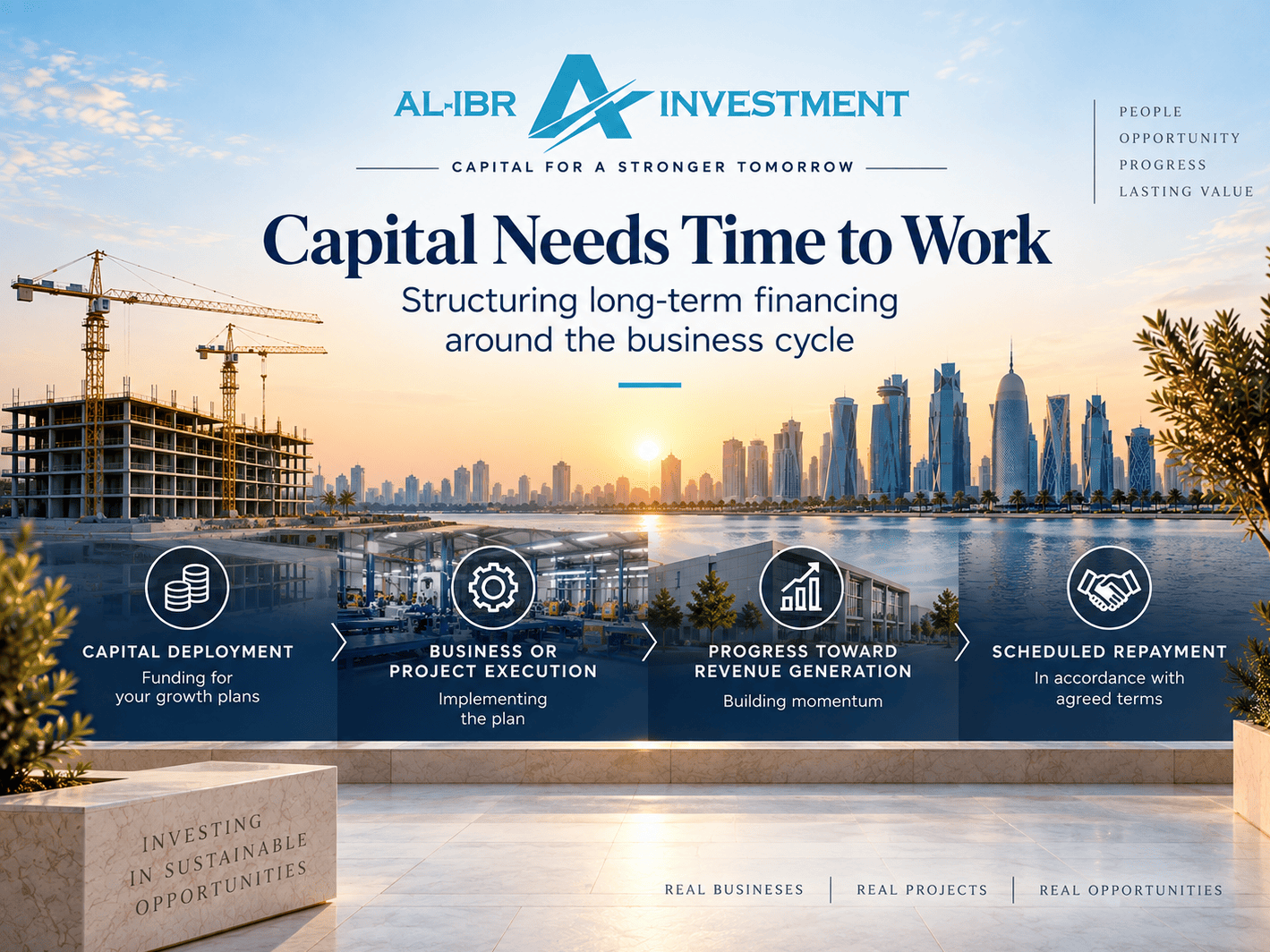
Capital Deployment → Business or Project Execution → Progress Toward Revenue Generation → Scheduled Repayment

Capital is first deployed toward the agreed commercial purpose.

The borrower then has an appropriate period to execute the underlying plan and progress the financed activity toward productive operations.

Scheduled repayment subsequently begins in accordance with the agreed financing structure.

The moratorium does not remove or diminish the borrower’s repayment obligations. Nor does it guarantee that a business or project will achieve a particular level of revenue within a specific period.

Instead, it recognizes an important commercial principle:

productive capital should have an appropriate opportunity to be put to work before scheduled repayment begins.

Different Opportunities Require Different Timelines

An established company expanding an existing operation may have a relatively short path between capital deployment and additional revenue.

A development project may require considerably more work before reaching operations.

For this reason, Al-Ibri evaluates financing opportunities individually. Our standard assessment considers the proposed transaction, funding requirement, intended use of funds and the underlying business or project before financing progresses.

The objective is not to impose an identical timeline on fundamentally different opportunities.

It is to structure long-term capital in a manner that recognizes the commercial characteristics of the transaction.

A Moratorium Supports Viability. It Does Not Replace It.

Providing time before scheduled repayment begins does not make an unviable business viable.

Commercial fundamentals still matter.

A borrower must have a credible business or project, an appropriate use for the capital and the capacity to support the proposed financing structure.

The moratorium is therefore not a substitute for financial discipline.

It is a structural feature intended to give a qualifying business or project an appropriate period to deploy the capital for which it was approved before scheduled repayment commences.

Structuring Capital Around Commercial Reality

At Al-Ibri Investment LLC, we provide long-term senior debt financing to qualified borrowers. Our standard financing parameters incorporate a 12 to 24-month moratorium, subject to transaction structure.

The principle behind that structure is straightforward:

Deploy the capital.

Execute the plan.

Progress toward revenue-generating operations.

Then commence scheduled repayment in accordance with the agreed financing terms.

We believe long-term financing should do more than provide capital. Its structure should recognize the commercial cycle of the business or project that capital is intended to support.

That is how we approach responsible long-term financing.

Trust, Transparency and Verification in International Investment Relationships

In international investment and financing, capital is only one part of a successful relationship.

Trust, transparency, accountability and the ability to verify the parties involved are equally important. Transactions increasingly cross jurisdictions and involve business owners, project sponsors, financial institutions, professional advisers and specialist counterparties. In that environment, establishing who is communicating, in what capacity and under whose authority is an important part of responsible business practice.

At Al-Ibri Investment LLC, we believe credible investment relationships should be built on clear communication, disciplined due diligence and verifiable corporate channels.

These principles are not separate from the investment process. They form part of the foundation on which long-term financial relationships are established.

Integrity Begins With Clear Corporate Identity

Every professional relationship begins with knowing who the parties are.

For businesses seeking investment or financing, this means understanding the identity of the capital provider with whom they are communicating. Equally, investment firms must understand the identity, ownership, management and authority of the businesses and individuals presenting opportunities to them.

Clear corporate identity reduces ambiguity and establishes accountability.

Al-Ibri Investment LLC therefore encourages counterparties to distinguish between information originating directly from the firm and communications involving independent third parties.

Where there is uncertainty regarding a communication, document, representative or claimed authority, verification should occur before reliance is placed upon it.

This principle is straightforward: important financial relationships should be capable of independent verification.

Official Communications Matter

International transactions can involve numerous participants.

Business owners may work with advisers. Project sponsors may engage consultants. Transactions may involve lawyers, accountants, brokers, technical specialists and other professional counterparties.

The involvement of third parties makes it particularly important to distinguish their communications from correspondence issued directly by an investment firm.

Official correspondence issued directly by Al-Ibri Investment LLC uses the firm’s @alibriinvestment.com email domain or another communication channel expressly confirmed by the firm.

A communication, document or representation claiming to originate from or be authorized by Al-Ibri through an unverified channel should not be relied upon merely because the company’s name, logo or information appears within it.

When uncertainty exists, the appropriate response is verification.

Verification Protects All Parties

Verification should not be viewed as an obstacle to doing business.

It protects businesses seeking capital. It protects investors and financing providers. It protects professional advisers. And it protects the integrity of the transaction itself.

Modern technology makes documents, company names, email signatures and other identifying information increasingly easy to reproduce. For that reason, appearance alone should never replace verification where a material financial decision is involved.

A professional counterparty should be comfortable confirming whether a communication is authentic, whether an individual is recognized by the organization they claim to represent, and whether a document genuinely originated from the stated issuer.

Al-Ibri maintains a dedicated corporate verification channel for this purpose.

Official verification enquiries may be directed to: verification@alibriinvestment.com

Due Diligence Is a Two-Way Responsibility

Due diligence is often discussed as something an investment firm conducts on a prospective transaction.

That is only one side of a responsible financial relationship.

Businesses and project sponsors should also conduct appropriate due diligence on prospective capital providers and the individuals with whom they communicate.

At the same time, an investment firm must establish that the business, project, management team and supporting information presented to it are genuine and capable of appropriate verification.

This creates a two-way standard.

At Al-Ibri, our assessment of qualifying opportunities may consider commercial fundamentals, financial position, management capability, ownership, transaction structure, security, risk profile and long-term viability.

Counterparties should likewise satisfy themselves regarding the identity and authority of the organization and representatives with whom they are conducting business.

Responsible due diligence strengthens rather than weakens a transaction.

Authority Should Never Be Assumed

One of the most important principles in cross-border business is that familiarity with a company name does not establish authority to represent that company.

Independent advisers, brokers, consultants and other professionals may participate in commercial transactions in their own capacities. Their involvement should not automatically be interpreted as creating employment, agency, partnership or authority to bind another organization.

Where a person represents that they are acting specifically on behalf of Al-Ibri Investment LLC, their authority should be capable of confirmation through the firm’s official channels.

This protects legitimate intermediaries as well.

It allows the respective roles of the investment firm, the prospective client and independent professional counterparties to remain clear throughout a transaction.

Transparency Does Not Mean Public Disclosure of Everything

Transparency and confidentiality are not contradictory principles.

Investment and financing transactions routinely involve commercially sensitive information. Financial statements, transaction structures, investment decisions, contractual arrangements and the identities of certain counterparties may appropriately remain confidential.

Responsible transparency means that information necessary for a party to make an informed decision can be provided through appropriate channels and subject to applicable confidentiality requirements.

It does not require confidential commercial relationships or transaction information to be placed in the public domain.

At Al-Ibri, relevant corporate, financial and transaction information may therefore be made available to authorized counterparties through established due diligence and transaction processes where appropriate.

This approach protects confidentiality while allowing legitimate verification to take place.

Consistency Builds Long-Term Confidence

Institutional credibility is not established by a single statement, document or transaction.

It is built through consistency.

The identity presented publicly should correspond with the identity used in official communications. Corporate representatives should be capable of verification. Transaction information should remain consistent throughout the assessment process. Material representations should be capable of appropriate substantiation.

For investment firms and businesses alike, these practices reduce uncertainty and help create stronger professional relationships.

They are particularly important in international transactions, where counterparties may operate across different jurisdictions and may never meet physically during the early stages of an opportunity.

Our Approach to Responsible Capital Relationships

Al-Ibri Investment LLC approaches investment and financing relationships with an emphasis on disciplined assessment, confidentiality, verification and long-term commercial alignment.

We believe that businesses seeking capital should be able to establish who they are dealing with, just as investment firms must be able to establish the identity and credibility of those seeking capital.

Our objective is to develop relationships in which responsibilities are clear, material information can be appropriately verified and qualifying investment opportunities can be evaluated on their commercial and financial merits.

Trust ultimately depends on more than words.

It depends on identity that can be confirmed, authority that can be verified, information that can be substantiated and professional conduct that remains consistent throughout the relationship.

For verification of communications, documents or individuals claiming to represent Al-Ibri Investment LLC, counterparties may contact the firm through its official corporate channels or at verification@alibriinvestment.com.